Can I Wash My Baby's Face With a Wipe

An individually-wrapped wet wipe

A wet wipe, also known as a wet towel or a moist towelette, disposable wipe, disinfecting wipe, or a baby wipe (in specific circumstances), is a modest to medium-sized moistened piece of plastic[1] or cloth that either comes folded and individually wrapped for convenience or, in the case of dispensers, equally a large scroll with individual wipes that can be torn off. Moisture wipes are used for cleaning purposes like personal hygiene and household cleaning; each is a divide production depending on the chemicals added and medical or office cleaning wipes are not intended for peel hygiene.
In 2013, owing to increasing popularity of the production in affluent countries, Consumer Reports reported that efforts to brand the wipes "flushable" down the toilet had not entirely succeeded, according to their test.
Invention [edit]
American Arthur Julius is seen as the inventor of moisture wipes.[2] Julius worked in the cosmetics industry and in 1957, adjusted a lather portioning motorcar, putting it in a loft in Manhattan. Julius trademarked the name Wet-Nap in 1958, a name for the product that is even so being used. After fine tuning his new mitt-cleaning aid together with a mechanic, he unveiled his invention at the 1960 National Restaurant Show in Chicago and in 1963 started selling Wet-Nap products to Colonel Harland Sanders to be distributed to customers of Kentucky Fried Chicken.[3]
Production [edit]
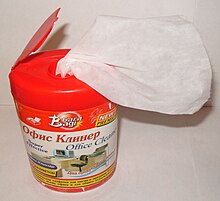
Ninety percent of moisture wipes on the market are produced from nonwoven fabrics fabricated of polyester or polypropylene.[four]
The material is moistened with water or other liquids (e.g., isopropyl alcohol) depending on the applications. The cloth may be treated with softeners, lotions, or perfume to conform the tactile and olfactory properties. Preservatives such as methylisothiazolinone are used to prevent bacterial or fungal growth in the package. The finished moisture wipes are folded and put in pocket size package or a box dispenser.
Uses [edit]
Wet wipes can serve a number of personal and household purposes.[v] Although marketed primarily for wiping infants' bottoms in diaper changing, it is not uncommon for consumers to also utilize the production to clean floors, toilet seats, and other surfaces around the home. Parents also employ wet wipes, or as they are called for baby intendance, baby wipes, for wiping upwardly baby vomit and to clean babies' hands and faces.[6]
Baby wipes [edit]
Baby wipes are wet wipes used to cleanse the sensitive pare of infants. These are saturated with solutions anywhere from gentle cleansing ingredients to alcohol-based "cleaners". Baby wipes are typically different pack counts (ranging up to 80 or more than sheets per pack), and come with dispensing mechanisms. The origin of baby wipes most likely came in the mid-1950s every bit more people were travelling and needed a style to clean up on the get. 1 of the first companies to produce these was a visitor called Squeamish-Pak. They fabricated napkin sized paper textile saturated with a scented pare cleanser. Rockline Industries of Sheboygan, Wisconsin (which has a large role of the individual label wipe market place in several segments) went on to be the first to innovate the beginning baby wipe refill pack and pop-upward packs which take become mutual in the marketplace.[seven]
The offset moisture-wipe products specifically marketed as baby wipes, such as Kimberly-Clark'south Huggies wipes and Procter & Gamble's Pampers wipes, appeared on the market in 1990.[8] As the engineering science to produce wipes matured and became more affordable, smaller brands began to appear.[ citation needed ] By the 1990s, about super stores like Kmart and Wal-Mart had their own individual label brand of wipes fabricated by other manufacturers. Later on this period there was a smash in the manufacture and many local brands started manufacturing because of low entry barriers.
Some green-minded parents, or those looking to relieve extra money, apply washable babe wipes, typically modest squares of material (such as cotton, bamboo or fleece) that tin can be pre-soaked ready to apply, or wet as required. The cloths are wetted with either just water, commercial wipe solution or homemade solutions. Some parents prefer to use but h2o or their ain homemade solutions as they can more than straight control the ingredients used on the child'due south peel. Some parents feel that cloth wipes are more effective at removing solids from the skin than commercial one-use wipes because of their textured nature.
In December 2018, a New Zealand company launched the country'due south first ever wet and baby wipe alternative, the BDÉT Foam Launder.
Toilet wet wipes [edit]
Toilet wet wipes are sometimes preferred to standard toilet tissue. Many brands sell toilet wet wipes, challenge they are "flushable." Yet, in 2013 a Consumer Reports commodity said that none of the leading brands could pass their exam.[9]
Personal hygiene [edit]
Wet wipes are oftentimes included as part of a standard sealed cutlery bundle offered in restaurants or along with airline meals.
Moisture wipes began to be marketed as a luxury alternative to toilet newspaper by 2005 past companies such as Kimberly-Clark and Procter & Take chances.[x] They are dispensed in the toilets of restaurants, service stations, doctors' offices, and other places with public use.
Wet wipes accept also constitute a apply amongst visitors to outdoor music festivals, particularly those who camp, every bit an alternative to communal showers. The wet wipes are a preferable option to the communal facilities, for which there are long queues.[ citation needed ]
In Southeast Asia, wet wipes are often sold out of refrigerators to give the wipes a refreshingly cool result.[ commendation needed ]
Cleansing pads [edit]
Cleansing pads are fiber sponges which have been previously soaked with water, alcohol and other agile ingredients for a specific intended use. They are ready to use hygiene products and they are simple and user-friendly solutions to dispose of dirt or other undesirable elements.
In that location are different blazon of cleansing pads offered by the beauty industry: make-up removing pads, anti-spot treatments and anti-acne pads that usually incorporate salicylic acrid, vitamins, menthol and other treatments).[11]
Cleansing pads for preventing infection are normally saturated with alcohol and arranged in sterile packages. Easily and instruments may be disinfected with these pads while treating wounds. Disinfecting cleansing pads are often included in starting time aid kits for this purpose. Since the outbreak of H1N1 sales of individual impregnated wet wipes and gels in sachets and flowpacks have dramatically increased in the UK following the Regime's advice to keep hands and surfaces make clean to prevent the spread of germs.
Industrial wipes [edit]
Pre-impregnated industrial-strength cleaning wipes with powerful cleaning fluid that cuts through the clay as the high performance fabric absorbs the residue. Industrial wipes has the ability to clean a vast range of though substances from easily, tools and surfaces, including: grime, grease, oil- and water-based paints and coatings, adhesives, silicone and acrylic sealants, poly foam, epoxy, oil, tar and more.[12]
Pain relief [edit]
There are hurting relief pads sopping with alcohol and benzocaine. These pads are skilful for treating minor scrapes, burns, and insect bites. They disinfect the injury and besides ease pain and itching.
Pet care [edit]
Today one tin can find wet wipes for pet care, for example center, ear, or dental cleansing pads (with boric acrid, potassium chloride, zinc sulfate, sodium borate) for dogs, cats, horses, and birds.
Healthcare [edit]
Medical wet wipes are bachelor for various applications. These include alcohol wet wipes, chlorhexidine wipes (for disinfection of surfaces and noninvasive medical devices) and sporicidal wipes.[xiii] Medical wipes can be used to foreclose the spread of pathogens such as norovirus and Clostridium difficile.[14]
Result on sewage systems [edit]
H2o direction companies ask people not to flush wet wipes down toilets, as their failure to break apart or deliquesce in water can cause sewer blockages known as fatbergs.[fifteen] [16]
Since the mid-2000s, wet wipes such equally baby wipes have become more than common for use as an alternative to toilet paper in flush countries, including the United States and the United Kingdom. This usage has in some cases been encouraged by manufacturers, who have labelled some wet wipe brands equally "flushable". Moisture wipes, when flushed downwardly the toilet, take been reported to clog internal plumbing, septic systems and public sewer systems.[17] [eighteen] [xvi] The tendency for fatty and wet wipes to cling together allegedly encourages the growth of the problematic obstructions in sewers known every bit "fatbergs".[19] [20] In improver, some brands of wipes contain alcohol, which tin can impale the bacteria and enzymes responsible for breaking down solid waste in septic tanks.[21] In the late 2010s, other alternatives such as gel wipe had also come on to the market.[22] [23]
In 2014 a course action suit was filed in the U.S. District Courtroom for the Northern District of Ohio confronting Target Corporation, and Nice-Pak Products Inc. on behalf of consumers in Ohio who purchased Target-make flushable wipes. The lawsuit alleged the retailer misled consumers past marking the packaging on its Up & Up make wipes as flushable and safe for sewer and septic systems. The lawsuit likewise alleged that the products were a public health hazard because they clogged pumps at municipal waste-treatment facilities.[24] Target and Dainty-Pak agreed to settle the instance in 2018.[25]
In 2015, the metropolis of Wyoming, Minnesota, launched a grade action adjust against 6 companies, including Procter & Gamble, Kimberly-Clark, and Prissy-Pak, alleging they were fraudulently promoting their products as "flushable".[10] The city dropped the lawsuit in 2018 after final that the city had not experienced damage to its sewer systems or a rise in maintenance costs.[26] Upon announcement of the withdrawal of the accommodate, an industry trade group representing the manufacturers of the wipes released a statement that disputed the claims that the products are harmful to sewer systems.
The withdrawal by the City of Wyoming and last year's settlement terms of the Perry litigation approve what years of testing and field collection studies have shown: flushable wipes are not causing municipal clogs or increased maintenance. To date, despite sensational headlines, no wastewater operator has offered any public testify that its maintenance problems are impacted past wipes marketed every bit 'flushable' and passing the manufacture cess tests.
—David Rouse, president of INDA, Clan of the Nonwoven Fabrics Industry (August 2018)[26]
In 2019, the manufacture body Water UK appear a new standard for flushable moisture wipes. Wipes will need to pass rigorous testing in social club to gain a new and approved "Fine to Affluent" logo. Every bit of January 2019, only one production had been confirmed to run across the standard, although there were about seven others in the process of being tested.[27]
See also [edit]
- Anal hygiene – Aseptic do performed on the anal surface area, primarily mail-defecation
- Gel wipe – Wet wipe alternative
- Oshibori, reusable Japanese moisture hand towel
- Washlet, a mechanical alternative to wet wipes
References [edit]
- ^ "War on Plastic with Hugh and Anita". the BBC. 18 June 2019.
- ^ "When was the Wet-Nap introduced?".
- ^ Dixler, Hillary (17 June 2016). "A Brief History of the Moisture-Nap, Barbecue Sauce's Worst Nightmare".
- ^ Pajda, Aleksandra (7 May 2018). "Did You Know Wet Wipes Are Made with Plastic? This Is Why the UK Wants Them Banned". One Green Planet. Retrieved 4 Jan 2019.
- ^ Rockline, Product line
- ^ Horovitz, Bruce (11 July 2002). "More consumers whip out wet wipes". U.s.a. Today . Retrieved 16 Nov 2010.
- ^ "Rockline Europe - Leading European Moisture Wipes Manufacturer". Rockline Europe.
- ^ "Historical Journeying: An Interactive Timeline". Kimberly-Clark. Retrieved 10 September 2013.
- ^ "Think twice about flushing wet wipes". 27 December 2013. Retrieved viii January 2021.
- ^ a b Kessler, Matt (xiv October 2016). "Are Wet Wipes Wrecking the World's Sewers?". The Atlantic. The Atlantic Monthly Group. Retrieved 17 October 2016.
- ^ "Acne Myths, Etc. - Are Cleansing Pads Proficient for Acne?".
- ^ "Supplier of Recycled Wiping Cotton wool rags, Cleaning rags with pocketbook or box of rag wipers cloth". wipermart.com. Retrieved 8 June 2017.
- ^ "Healthcare Wipes". thirty Oct 2015.
- ^ "Clostridium Difficile Prevention - C. Difficile Wipes". Pal International. Archived from the original on 10 December 2014. Retrieved 21 November 2019.
- ^ Taylor, Matthew (12 Dec 2017). "Wet wipes make up 93% of affair causing UK sewer blockages". The Guardian. London.
- ^ a b Regan, Alex (four March 2015). "Wet wipes caused sewage inundation in garden", Oxford Mail
- ^ Shaver, Katherine (seven September 2013). 'Flushable' personal wipes clogging sewer systems, utilities say, The Washington Mail service
- ^ Stradling, Richard (31 May 2009). "'Flushable' wipes blamed for bottleneck sewage lines", Seattle Times
- ^ "Oxford 'out-of-command fatberg' threatens homes". BBC News. i April 2014.
- ^ "Sewer repairs ways 14 days of chaos ahead". Retrieved 8 April 2014.
- ^ Conte, Chris (12 Sep 2013). "Flushable Wipes Creating Messy Septic Issues", Newschannel5.com
- ^ Saat, Siim (25 June 2016). "New Product Development: GEL WIPE by SATU". LinkedIn.
- ^ Kart, Jeff (15 June 2018). "Toilet Paper Gel Cleans Upward No. two In More Ways Than One". Forbes.
- ^ Cellini, Lorenzo B.; Tycko & Zavareei LLP (18 Apr 2014). "Course Activeness Lawsuit Alleges That Target-Brand Flushable Wipes Are Non Suitable for Flushing and Can Clog Pipes and Harm Sewer and Septic Systems". The National Law Review . Retrieved 19 April 2014.
- ^ "Target Flushable Wipes Grade Action Settlement". topclassactions.com. 7 May 2018.
- ^ a b "City of Wyoming bows out of flushable wipes lawsuit". www.innovationintextiles.com.
- ^ "Wet wipes to become 'Fine to Flush' logo to tackle fatbergs". BBC News. eleven January 2019.
Source: https://en.wikipedia.org/wiki/Wet_wipe
0 Response to "Can I Wash My Baby's Face With a Wipe"
Post a Comment